
DISTANCE PROTECTION (ANSI 21)
Operating Principles, Fault Location Capability, and Challenges Associated with Load Encroachment and IBR Integration
Distance protection (ANSI 21) is one of the most widely applied protection schemes for transmission lines due to its capability to estimate the electrical location of a fault through apparent impedance measurement. Unlike overcurrent protection schemes, its performance is largely independent of variations in short-circuit current magnitude caused by network topology changes or varying operating conditions of the power system.
This paper reviews the operating fundamentals of distance protection, its application as a fault location tool, and two of the main challenges associated with its practical implementation: the influence of load current (load encroachment) and the impact of Inverter-Based Resources (IBRs), which may lead to undesired relay operations in the absence of actual faults. Engineering criteria aimed at simultaneously preserving protection selectivity, security, and reliability are also discussed.
1. Introduction
Reliable protection of transmission lines is a fundamental requirement to ensure stability and continuity of service in modern power systems. Traditionally, protection schemes have relied on current-based quantities, as is the case with overcurrent protection. However, fault current magnitude strongly depends on the equivalent system impedance, network topology, and connected generation levels, introducing uncertainty in protection coordination and reduced sensitivity to remote faults.
Distance protection emerged as a conceptual evolution by introducing a criterion based on the electrical location of the disturbance. Instead of evaluating only current magnitude, the relay estimates the impedance between its installation point and the fault location, interpreting this value as an electrical distance within the network. This principle enables higher levels of selectivity and faster fault clearing while reducing dependence on system operating conditions, thereby establishing ANSI 21 distance protection as the predominant scheme for high-voltage transmission lines.
2. Operating Principle of Distance Protection
2.1. Apparent Impedance Measurement and Fault Loops
Distance protection operates based on the continuous calculation of the apparent impedance observed from the relay location.
The measurement principles, accuracy requirements, and dynamic performance associated with this function are defined in IEC 60255-121:2014, which constitutes the international reference standard for distance protection relays applied in electric power systems. From an application and engineering perspective, documents such as IEEE Std C37.113 provide practical recommendations for proper implementation, coordination, and setting calculation in real transmission networks.
In order to achieve the required selectivity and measurement accuracy, distance protection does not rely on a single phasor relationship. Instead, the measuring unit evaluates specific fault loops depending on the fault type:
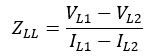
Phase-to-phase faults (L-L). The apparent impedance is calculated using phase quantity differences, effectively eliminating the influence of load current:
Phase-to-ground faults (L-G). Zero-sequence compensation must be included to avoid underreach or overreach errors caused by the return path impedance:
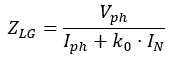
where k0 represents the residual compensation factor accounting for the inequality between zero-sequence and positive-sequence impedances (Z0≠Z1) typically present in overhead transmission lines.
During fault conditions, local voltage decreases while current increases, producing a significant reduction in apparent impedance. When this value enters the predefined operating characteristic of the relay, the protection determines that the fault lies within its protected zone and issues a trip command to the associated circuit breaker.
This operating principle ensures that relay performance depends primarily on the electrical distance to the disturbance rather than on the absolute magnitude of fault current, providing improved selectivity and stability under varying loading and generation conditions.
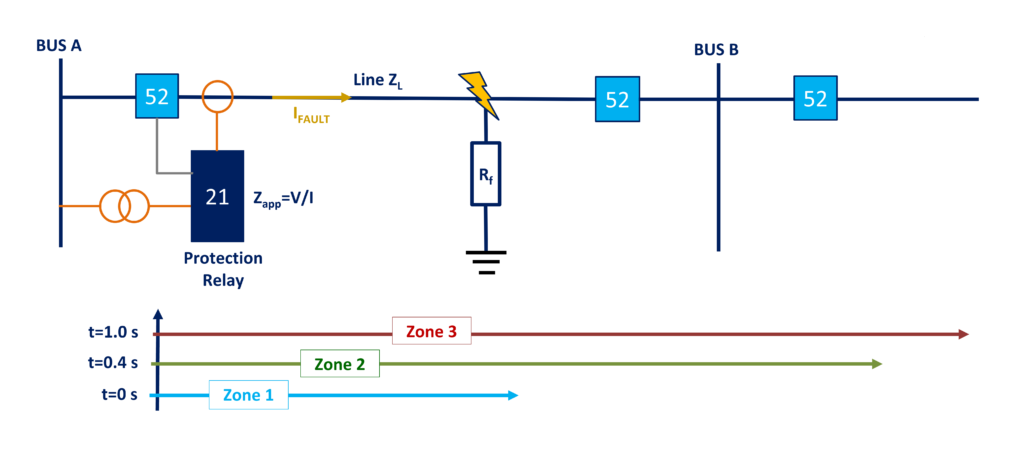
Distance Protection (ANSI 21) Scheme.
2.2. Representation in the R–X Plane
Relay operation is evaluated in the resistance–reactance (R–X) plane, where tripping characteristics define geometric regions associated with internal fault conditions. This representation allows simultaneous consideration of both resistive and reactive components of the measured impedance, improving discrimination between normal operating conditions and genuine fault events.
Among the most commonly applied operating characteristics are the following:
Mho characteristic: The Mho characteristic exhibits a circular shape in the R–X plane and provides inherent directional properties. However, due to its expansion toward the load region, it may present increased sensitivity to load encroachment phenomena, particularly in long transmission lines operating under high power transfer conditions.
Quadrilateral characteristic: The quadrilateral characteristic allows independent adjustment of fault resistance (Rf) and reactance (X), and reactance reach, enabling improved sensitivity to high-resistance faults while facilitating the implementation of load exclusion regions (load blinders). This flexibility makes it especially suitable for modern transmission systems where loadability and power flow variability must be considered during protection setting design.
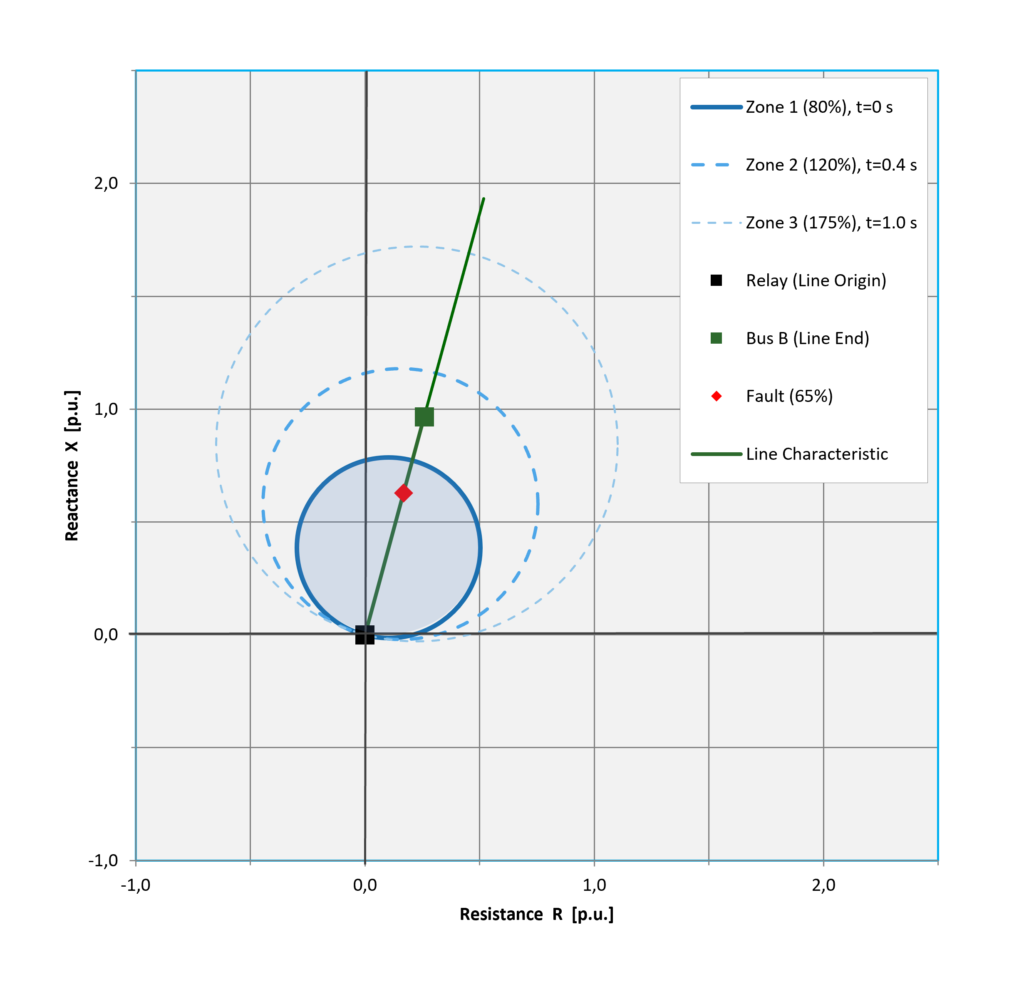
R-X Diagram. Mho characteristic of distance relay for Zone 1, zone 2 and zone 3.
2.3. Protection Zones and Coordination
Distance protection divides the transmission line into coordinated protection zones with progressively increasing reach and time delays.
Zone 1: typically covers between 80% and 90% of the protected line and operates without intentional time delay, ensuring fast clearing of internal faults.
Subsequent zones (Zone 2 and Zone 3): extend their reach beyond the protected line into adjacent sections using graded time delays, thereby providing backup protection for faults not cleared by Zone 1.
This philosophy ensures that the electrically closest protection device operates first, preserving selectivity and overall protection system reliability.
Some protection schemes additionally include a Zone 4, configured in the reverse direction relative to the protected line. This zone provides backup protection for faults located behind the relay location, such as adjacent bus faults, failures of local protection systems, or loss of selectivity in neighboring protection elements.
Due to its extended reach and longer operating delay, Zone 4 is set using highly conservative criteria to avoid undesired tripping during heavy loading conditions or power swing events. In many modern transmission systems, its function is complemented or partially replaced by dedicated busbar protection schemes or advanced directional supervision functions integrated into numerical relays.
In modern transmission networks, distance protection rarely operates as a standalone scheme. The portion of the line not instantaneously protected by Zone 1 is typically secured through teleprotection schemes, which employ communication channels between both line terminals to accelerate fault clearing.
These schemes enable nearly simultaneous tripping at both ends when the fault is located within the protected line, avoiding reliance solely on Zone 2 time delays. Among the most commonly applied schemes are:
POTT (Permissive Overreaching Transfer Trip): Permissive tripping scheme based on overreaching distance elements. Each terminal transmits a permissive signal when its overreaching element detects a forward fault, allowing high-speed tripping when both terminals confirm an internal fault condition.
PUTT (Permissive Underreaching Transfer Trip): Acceleration scheme based on underreaching Zone 1 elements. A terminal detecting a fault within its underreaching zone sends a permissive signal to the remote end, enabling fast tripping coordination between line terminals
DCB (Directional Comparison Blocking): Blocking scheme in which tripping is permitted unless a blocking signal is received from the opposite terminal indicating that the fault has been detected in the reverse or external direction.
The use of teleprotection schemes enables practically instantaneous fault clearing along the entire line length, a fundamental requirement in extra-high-voltage transmission networks where critical clearing times typically range below 100–250 ms, in accordance with operational criteria applied by European transmission system operators such as Red Eléctrica de España (REE).
3. ANSI 21 Distance Protection as a Fault Location Tool
Modern numerical relays incorporate advanced diagnostic functions capable of accurately estimating fault location. Once a disturbance is detected, the relay calculates the impedance corresponding to the fault point and compares it with the configured positive- and zero-sequence line impedances in order to estimate the physical distance to the fault.
However, measurement accuracy may be affected by several factors.
3.1. Infeed Effect
In transmission lines energized from both terminals, current contribution from the remote end increases the apparent fault resistance observed by the relay, leading to underreach errors in fault location estimation. Mathematically, the apparent impedance measured by a single-ended locator is influenced by the additional current infeed from the remote terminal.:

This phenomenon introduces an inherent error in single-ended fault location algorithms. Modern relay implementations attempt to compensate for this effect to improve maintenance crew dispatch accuracy and preserve overall protection scheme selectivity.
3.2. Arc Resistance
The presence of an electric arc during a fault introduces an additional resistance component (Rarc) that shifts the apparent impedance toward the positive resistance axis in the R–X plane, potentially placing an internal fault outside the relay tripping characteristic. This overreach effect becomes particularly significant in high-impedance faults involving free-burning arcs.
To ensure protection scheme dependability, sensitivity studies must be performed considering the maximum expected arc resistance, following the recommendations provided in Section 6.4 of IEEE C37.113-2015. Such studies allow proper relay setting adjustments and minimize the risk of undetected internal faults.
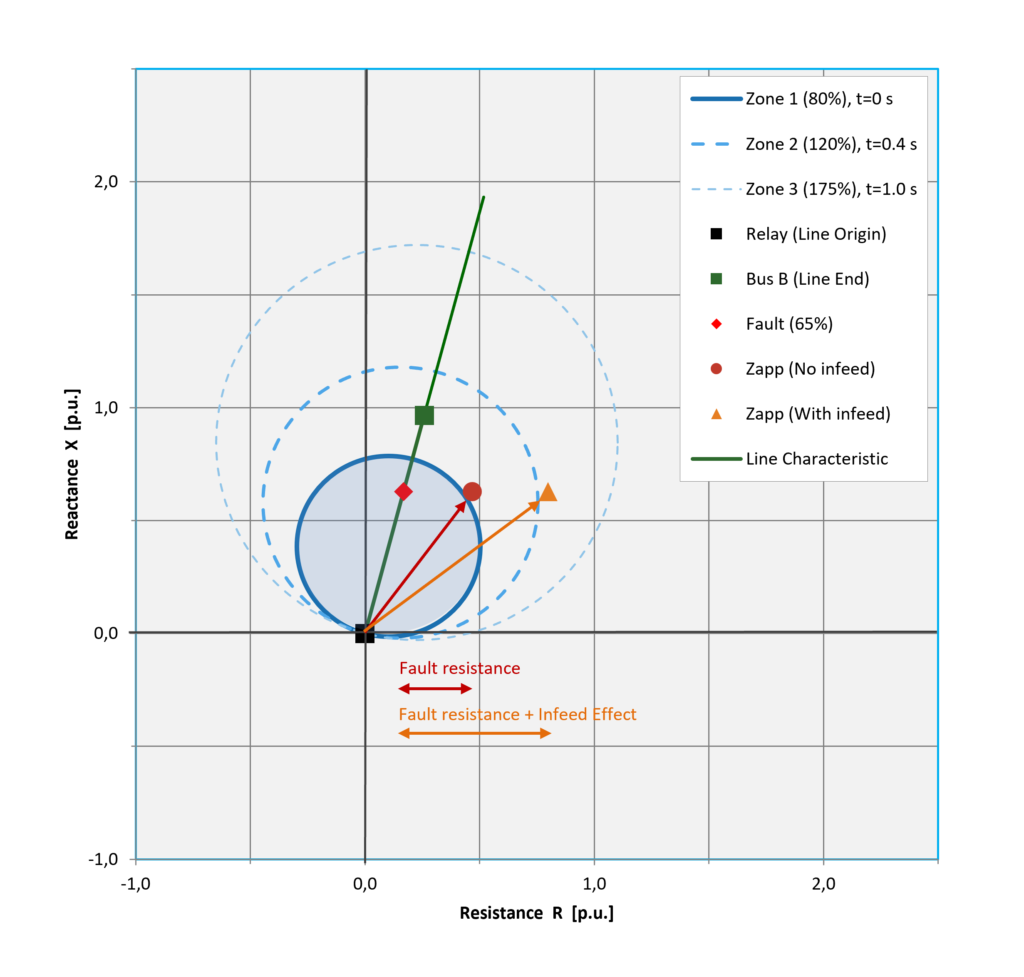
R-X Diagram. infeed effect on Apparent Impedance measured By distance protection (aNSI 21).
4. The Load Encroachment Challenge
Under normal operating conditions, the impedance observed by the relay depends on the system power angle. Typically, this operating point remains outside the tripping characteristic; however, under extreme operating conditions it may migrate toward the fault region, creating a risk of undesired tripping known as load encroachment.
Since apparent impedance is calculated as the ratio between voltage and current, a reduction in voltage accompanied by high current levels—typical of heavily loaded lines or electrically weak systems characterized by high System Impedance Ratio (SIR)—results in a reduction of the measured impedance magnitude. From the relay perspective, this condition may become indistinguishable from a remote fault, increasing the probability of unintended operation.
The risk of load encroachment depends not only on current magnitude but also on the load impedance angle. During extreme power transfers near system stability limits, the load impedance angle may approach the relay characteristic angle, particularly within Zone 2 and Zone 3 elements, thereby increasing the likelihood of misoperation.
To mitigate this effect, the implementation of load blinder characteristics is recommended. These are typically configured in a V-shaped or wedge-shaped region that excludes the load impedance area from backup zone tripping decisions.
The challenge becomes especially critical in the following scenarios:
El desafío es particularmente crítico en:
Long interconnections, where load currents are significant and impedance angles may approach the tripping region.
Series-compensated transmission lines, which modify the voltage–current relationship and affect the apparent impedance measurement.
Systems with high power transfer levels, where load impedance displacement may dangerously approach the relay operating characteristic.
Careful consideration of load encroachment phenomena is essential to preserve selectivity and reliability of distance protection schemes, particularly in modern transmission networks with high penetration of distributed generation and strongly interconnected grids.
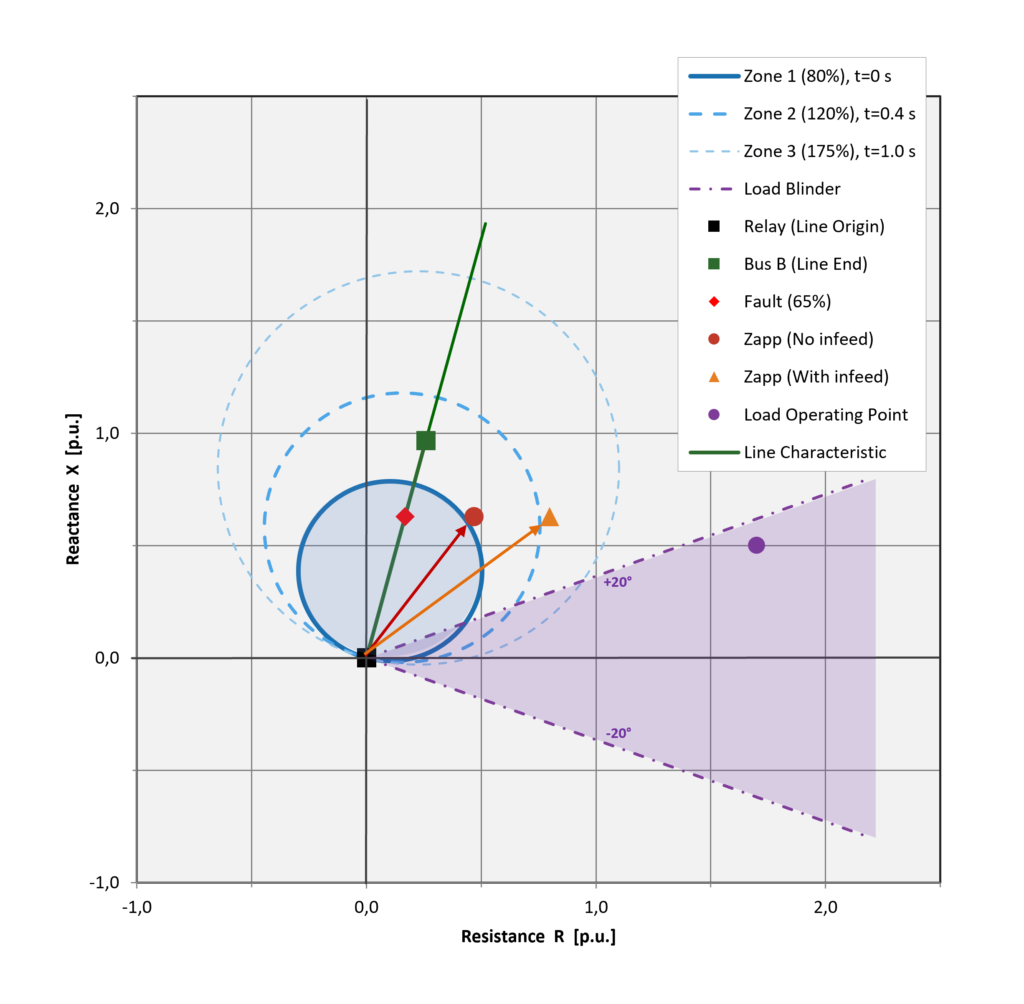
R-X Diagram. V-Shaped Load Blinder.
5. Integration of Inverter-Based Resources (IBR)
The integration of Inverter-Based Resources (IBRs) significantly modifies the behavior of ANSI 21 distance protection. Unlike synchronous generators, IBRs typically limit their fault current contribution to approximately 1.1–1.5 pu and frequently suppress negative-sequence current components to protect power electronic converters. As a consequence, the impedance measured by the relay may not decrease as sharply during faults, and phase-selection algorithms based on symmetrical components may fail, increasing the risk of underreach or fault non-detection.
IBRs can be broadly classified according to their operational control mode:
Grid-following: these resources depend on an external phasor reference obtained through a Phase-Locked Loop (PLL) to synchronize with the grid. During severe faults, synchronization loss may occur, altering the injected current angle and consequently affecting the apparent impedance observed by the distance relay.
Grid-forming: maintain an internal voltage reference, allowing a more predictable fault current contribution. However, their penetration in high-voltage transmission systems remains limited at present.
Both IBR types may omit or significantly reduce negative-sequence current injection, compromising phase-selection algorithms based on symmetrical components and increasing the risk of incorrect relay operation.
The standard IEEE Std 2800-2022 (Standard for Interconnection and Interoperability of Inverter-Based Resources) establishes technical requirements for IBR interconnection and operation, including fault current injection capabilities and ride-through performance requirements (LVRT/HVRT).
Complementarily, reliability standards issued by the North American Electric Reliability Corporation (NERC) applicable to IBR integration—particularly PRC-024 (voltage–frequency ride-through curves) and PRC-019 (reactive control coordination), define operational criteria that directly influence dynamic resource behavior during system disturbances.
For this reason, ANSI 21 distance protection settings in systems with high IBR penetration must be supported by fault simulations incorporating validated generic control models such as WECC/EPRI representations, calibrated against field measurements to ensure reliable relay performance under realistic operating conditions.
6. Mitigation Techniques and Engineering Criteria
Reliable performance of ANSI 21 distance protection largely depends on the engineering process applied during relay setting and coordination. To ensure selectivity, security, and dependability, it is necessary to analyze not only fault scenarios but also extreme normal operating conditions, including maximum power transfer, minimum voltage levels, and network topology variations.
Modern numerical relays incorporate load blocking functions and advanced supervisory tools that allow the definition of regions in the R–X plane where tripping is inhibited, even when the apparent impedance partially enters the protection characteristic. Among the most relevant mitigation techniques are the following:
Load Blinders: V-shaped or wedge-shaped characteristics designed to exclude the load impedance region from Zone 2 and Zone 3 tripping decisions, thereby mitigating the risk of load encroachment.
Directional Supervision and Power Swing Blocking: These functions prevent undesired operations during dynamic phenomena not associated with short circuits, such as power swings or voltage transients.
System Impedance Ratio (SIR) Analysis: Evaluation of the System Impedance Ratio allows classification of the network as electrically strong or weak, enabling appropriate relay sensitivity adjustment to avoid tripping during transient voltage depressions.
Prevention of protection misoperations requires careful design supported by comprehensive power system studies. This approach aligns with the setting and coordination methodologies described in CIGRE Technical Brochure 660, an internationally recognized reference compiling practical engineering criteria derived from operational experience and real distance protection performance analyses.
Practical engineering recommendations include:
Conservative Zone 1 reach settings, reducing sensitivity to voltage depressions or remote current contributions.
Directional supervision combined with power swing blocking to avoid unintended operations during dynamic system phenomena.
Ensuring accurate transmission line electrical parameters, as these directly affect tripping selectivity and fault location accuracy.
Proper configuration of the R–X plane to maintain clear separation between load trajectories and fault operating regions, preventing interaction between normal operating conditions and short-circuit events.
The proper integration of these techniques enables optimization of protection scheme selectivity and dependability, even in systems characterized by high IBR penetration, long transmission lines, series compensation, or extreme operating conditions.
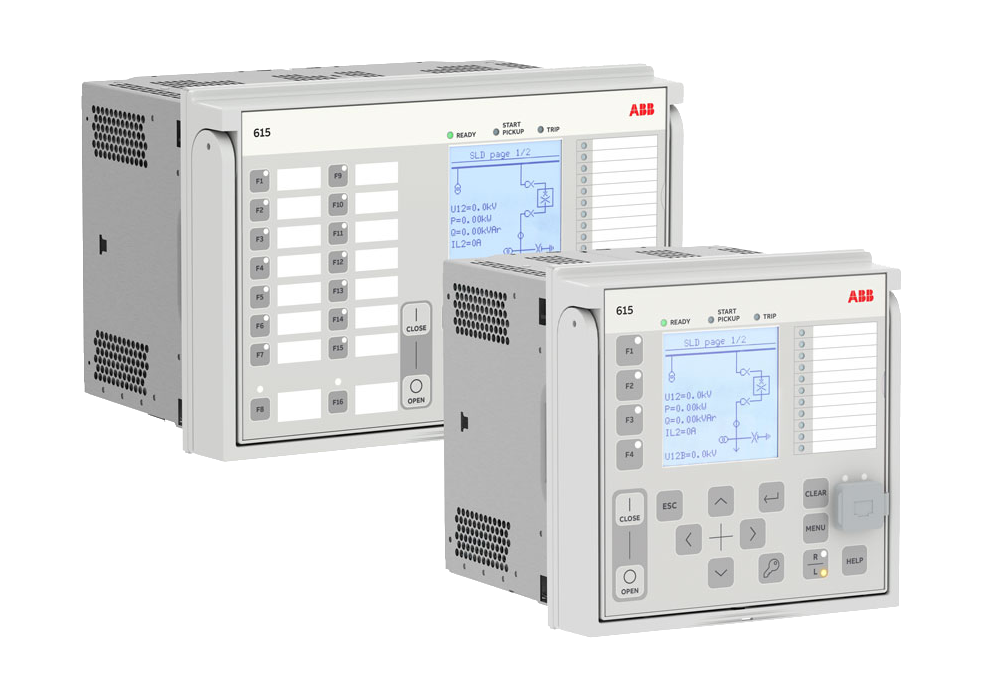
Advanced Protection & control relays.
7. Conclusions
ANSI 21 distance protection remains one of the most effective protection schemes for transmission lines, owing to its capability to estimate the electrical distance to a fault and provide fast and selective fault clearing.
Nevertheless, the operation of modern power systems introduces additional challenges, primarily associated with heavily loaded operating conditions. Load current may modify the apparent impedance to values close to those corresponding to an actual fault if relay settings do not properly consider system operating limits, thereby increasing the risk of undesired tripping due to load encroachment.
When applied using sound engineering criteria, distance protection transcends its traditional tripping function and becomes a key element for system monitoring, diagnostics, and overall grid resilience.
The increasing penetration of Inverter-Based Resources (IBRs) represents the most significant challenge for ANSI 21 protection in the coming decade. Limited fault current magnitude, reduced or absent negative-sequence current injection, and dependence on inverter control modes require a comprehensive reassessment of traditional protection setting and coordination practices.
As a future research and development direction, the integration of adaptive protection schemes based on IEC 61850 GOOSE communications is recommended, incorporating supervisory logic sensitive to real-time IBR penetration levels, in line with recommendations from CIGRE WG B5.50 and guidance developed within the IEEE Power System Relaying and Control Committee (PSRC). Such an approach would help maintain protection reliability and selectivity under the evolving challenges posed by modern power systems with high renewable penetration and distributed energy resources.
References
[1]
A. G. Phadke y J. S. Thorp, Computer Relaying for Power Systems, Wiley, 2009.
[2]
IEEE Power System Relaying Committee, IEEE Guide for Protective Relay Applications to Transmission Lines, IEEE Std C37.113-2015.
[3]
P. M. Anderson, Power System Protection, McGraw-Hill, 1999.
[4]
S. H. Horowitz and A. G. Phadke, Power System Relaying, 4th ed., Wiley-IEEE Press, Chichester, UK, 2014.
[5]
CIGRÉ Study Committee B5, “Analysis and Comparison of Fault Location Systems in AC Power Networks,” CIGRÉ Electra, Technical Brochure, 2022.
[6]
B. Kasztenny and R. Chowdhury, “Security Criterion for Distance Zone 1 Applications in High SIR Systems With CCVTs – Part 1: Transient Errors,” CIGRÉ Science & Engineering, no. 36.
[7]
X. Wang et al., “The Identification of Transmission Line Overload and Fault Based on Ucosφ,” Proc. CIGRÉ Canada Conference, Montréal, 2019.
[8]
IEEE Standards Association, IEEE Standard for Interconnection and Interoperability of Inverter-Based Resources (IBR) Interconnecting with Associated Transmission Electric Power Systems, IEEE Std 2800-2022, Apr. 2022.
EOHM© 2026